TL;DR: Market volatility is shaping today’s investing landscape, driven by inflation, interest rates, and global uncertainty. This blog explains how investors can navigate market volatility with practical, long-term strategies to protect and grow their finances.
Main points:
- Build a strong financial foundation with budgeting, debt reduction, and emergency savings
- Align your investments with your personal risk tolerance to stay confident during swings
- Diversify your portfolio across assets and sectors to reduce exposure to risk
- Seek multiple expert perspectives to strengthen financial decision-making
- Stay focused on long-term goals and avoid emotional reactions to short-term market changes
Recent years have continued to test investors in new ways. Ongoing geopolitical tensions, persistent inflation concerns, shifting interest rates, and uncertainty around global growth have all contributed to market volatility.
Markets have shown sharp swings, often reacting quickly to inflation data, central bank policy changes, geopolitical tensions, trade developments, and shifting expectations around global economic growth.
So how do we navigate these volatile times? How do we protect our finances? There are several strategies that I guide my clients through.
1. Have a Plan for Market Volatility
Benjamin Franklin is credited with the saying that “failing to plan is planning to fail,” and that is true when it comes to your retirement and your overall finances.
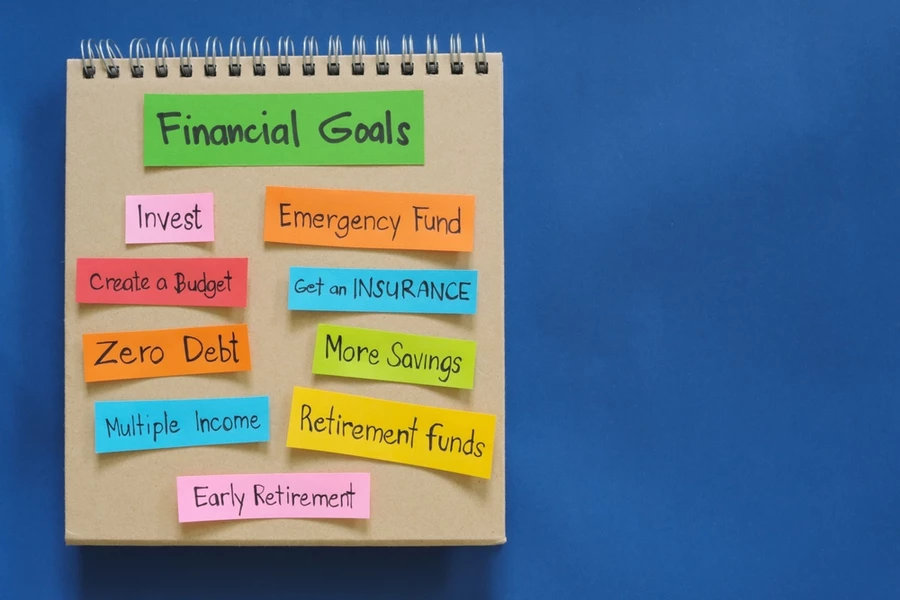
This is the basics for a financial plan:
- Budget your income and expenses
- Pay down high-interest debt
- Contribute consistently to retirement accounts
- Build an emergency fund (3–6 months of expenses)
You don’t have to designate where every single dollar is going, instead, you can follow the 80/20 rule:
- 20% of income should go to savings, investments, debt repayment, etc.
- 80% of income should go to living expenses and discretionary spending.
There are many financial plans you can follow, and what works for your friend may not work for you. That’s why it’s important to meet with a financial advisor to turn your dreams into a fool proof, comprehensive plan.
2. Gauge Your Risk
How comfortable are you with risk? No matter what kind of investor you are, there is usually going to be some risk. There are several kinds of quizzes and resources out there that will gauge your risk tolerance; I recommend this one from Charles Schwab.
Understanding your tolerance is a core part of how to manage investment risk. Conservative investors should minimize their exposure to risk or they will be extremely uneasy during these volatile time periods. Don’t bet more than you are willing to lose, especially if you are at or nearing retirement age.
The goal is alignment. When your strategy matches your comfort level, staying invested during volatile markets becomes easier.
3. Diversify Your Portfolio
Diversification remains one of the most effective investment strategies for volatile markets. As the old saying goes, don’t put all your eggs in one basket. Your portfolio should be diversified to withstand the ebbs and flows of a volatile market.
In order to reduce your risk as an investor, your portfolio should blend different investments by spreading the wealth amongst a variety of sectors. You might consider a mutual fund, ETFs(exchange-traded funds) or real estate investment trusts. Don’t just narrow your options to what you see in the stock market.
Diversifying will spread your investments out to limit a great deal of exposure on a singular asset. It also supports the principle that dollar cost averaging reduces impact of market volatility, especially when combined with consistent investing.
4. Diversify Ideas and Sources of Financial Information
Beyond diversifying your portfolio, you should also be diversifying your money management. Do you have someone you trust guiding you through volatile financial times? At Asset Preservation Tax & Retirement Services, we don’t just rely on the guidance of our advisors, we meet with money managers and advisors at BlackRock, some of the smartest financial professionals in the entire world.
We’re constantly looking for ways to diversify ideas, learn and evolve to do things better and provide the soundest advice to our clients.
5. Focus on the Long Term
Short-term thinking can damage long-term results. One of the most important habits is staying invested during volatile markets. Volatility in the market is to be expected, but the real mark of a successful money manager is someone who can withstand the tides.
I tell my clients to never let their emotions get the best of them. When the market is down, don’t run from it and panic-sell. Instead, run to a trusted financial advisor who will help you build a financial plan that can withstand even the highest tides.
Frequently Asked Questions
What Does Market Volatility Mean?
Market volatility refers to how much and how quickly the price of an asset, index, or market fluctuates over time. High volatility means prices move sharply up or down, while low volatility indicates more stable, gradual price changes.
Is Market Volatility Good or Bad?
Market volatility is neither inherently good nor bad; it depends on the investor’s perspective. It can create opportunities for traders to profit from price swings, but it also increases risk and uncertainty, especially for long-term investors seeking stability.
What Does Warren Buffett Say About Volatility?
Warren Buffett has stated that volatility is not the same as risk. He emphasizes that short-term price fluctuations do not necessarily reflect the true value of an investment and encourages focusing on long-term fundamentals rather than reacting to market swings.
Is 20% Volatility High?
A volatility level of 20% is generally considered moderate to high, depending on the context. In equity markets, it often signals increased uncertainty or risk, especially compared to historical averages closer to 10–15%.
Stewart Willis is the founder and president of Asset Preservation Wealth & Tax, a financial planning firm in Phoenix, Arizona. Investment advisory services offered through Foundations Investment Advisors, LLC, an SEC registered investment adviser.
The commentary on this blog reflects the personal opinions, viewpoints and analyses of the author, Stewart Willis, providing such comments, and should not be regarded as a description of advisory services provided by Foundations Investment Advisors, LLC (“Foundations”), an SEC registered investment adviser or performance returns of any Foundations client. The views reflected in the commentary are subject to change at any time without notice. Nothing on this website constitutes investment, legal or tax advice, performance data or any recommendation that any particular security, portfolio of securities, transaction or investment strategy is suitable for any specific person. Personal investment advice can only be rendered after the engagement of Foundations for services, execution of required documentation, including receipt of required disclosures. Any mention of a particular security and related performance data is not a recommendation to buy or sell that security. Foundations manages its clients’ accounts using a variety of investment techniques and strategies, which are not necessarily discussed in the commentary. Any statistical data or information obtained from or prepared by third party sources that Foundations deems reliable but in no way does Foundations guarantee the accuracy or completeness. Rates and Guarantees provided by insurance products and annuities are subject to the financial strength of the issuing insurance company; not guaranteed by any bank or the FDIC. Investments in securities involve the risk of loss. Any past performance is no guarantee of future results. Advisory services are only offered to clients or prospective clients where Foundations and its advisors are properly licensed or exempted. For more information, please go to https://adviserinfo.sec.gov and search by our firm name or by our CRD # 175083.